QA with Nurse Scientist Michael Cary
Dr. Michael Cary shares factors that shaped his career, his philosophy of mentorship, and how Duke has supported his research and interdisciplinary collaboration.
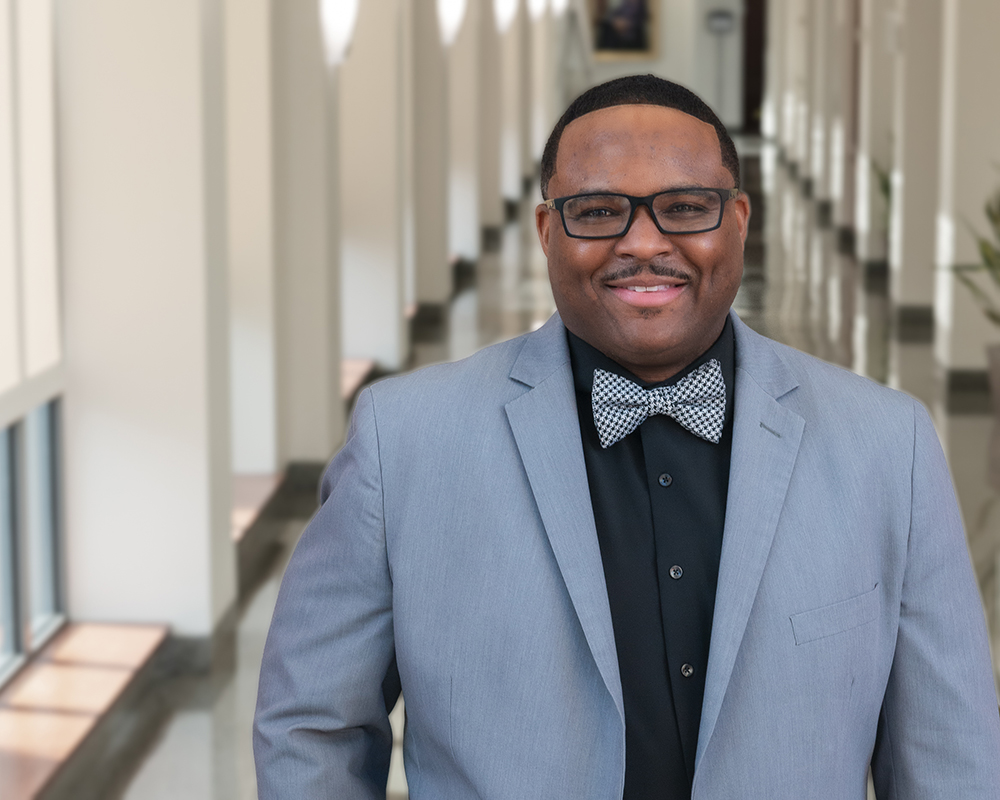
Dually trained as a health services researcher and an applied data scientist, Associate Professor Michael Cary, PhD, RN, FAAN uses AI to study health disparities related to aging and to build practical strategies that make care safer, fairer, and more effective for older adults.
Dr. Cary— whose research has been supported by the National Library of Medicine and the National Institute of Nursing Research—shared factors that shaped his career, his philosophy of mentorship, and how Duke has supported his research and interdisciplinary collaboration.
What first inspired you to become a nurse scientist and pursue your areas of research?
My journey to becoming a nurse scientist began with an early fascination for how health systems work and who they work best for. I earned my first degree in Health Services Administration at James Madison University and shortly after graduation moved to Largo, Maryland, to work at a major managed health care company in the in the Quality Management division. In that role, I analyzed quality and utilization data across our post-acute and long-term care network. I quickly learned that outcomes aren’t shaped by clinical decisions alone. They’re also shaped by systems, such as policy, financial incentives, access, and the resources that patients do or don’t have.
When the company faced financial challenges and our regional office closed, I found myself at a crossroads. My manager at the time, Fernando Gruta, had been a nurse for many years before earning his MBA and moving into healthcare management. He offered advice that changed my career path, encouraging me to consider nursing so I could integrate business and analytical training with clinical competency. I later enrolled in a second degree program at the University of Virginia (UVA).
At UVA, my clinical training immersed me in various clinical settings, but I enjoyed post-acute care and rehabilitation settings the most. There, the quality metrics I had once analyzed became personal—older adults rehabilitating and attempting to recover from illness or injury, families navigating fragmented systems, and patients whose outcomes depended on far more than what happened in the acute hospital settings. I began asking deeper questions: Why do some older adults recover well, while others struggle? What happens after hospital discharge that determines whether someone returns to the community or cycles back to the hospital? And how do structural and social factors shape those outcomes?
Today, my research continues to build on that origin story. My research asks a simple but urgent question: why do older adults experience different outcomes—and how do we design care systems that work better for everyone? By integrating social determinants of health into the development and evaluation of AI models, I focus on building tools that are both more useful and less likely to encode inequities. The goal is actionable intelligence that better supports clinicians and care teams during discharge planning, transitions in care, and long-term outcomes. Just as important, my work focuses on the “last mile” problem, which is ensuring that what we build can be implemented responsibly and health professionals are trained to deliver safe care in practice.
What has been the impact of mentorship on your career?
Mentorship has been transformative at every stage of my career. Mentors helped me recognize my potential before I fully recognized it myself. They encouraged me to pursue doctoral training, to step into leadership roles, and to trust that my voice and perspective belonged in academic spaces where I was often one of very few—or the only—Black faculty member.
During my final year of my undergraduate program at UVA, I took a research elective with Dr. Courtney Lyder. He was the first tenured Black faculty member at UVA, a division chair, and clinical researcher, which was particularly powerful for me to see, as [I knew] no other Black scientists at that time. Before Dr. Lyder left to become the Dean of UCLA School of Nursing, he encouraged me to pursue a career as a scientist. Dr. Elizabeth Merwin, a health services researcher, was my graduate school advisor and later became my dissertation chair. She was also a defining influence in my development as a nurse scientist. She not only sustained encouragement but helped me build the technical foundation—learning how to translate large, complex datasets into clinically meaningful insights—that now underpins my AI and health equity work. As role models, their mentorship helped crystallize my purpose and set me on the path to becoming a nurse scientist.
Over time, I’ve learned that mentorship isn’t only about guidance—it’s also about sponsorship: opening doors, creating access to networks, and helping people step into opportunities that accelerate their professional growth. Now, you can see that philosophy reflected in my own leadership and mentoring initiatives I’ve helped build nationally: the AcademyHealth Interdisciplinary Research Group on Nursing Issues (IRGNI) Emerging Diversity Leaders, and the Network for Black Male Nurse Leaders.
How do you approach mentorship and fostering the next generation of nurse scientists?
I view mentorship as both a responsibility and a commitment to the future of the profession. My goal is simple—to help the next generation of nurse scientists develop the confidence, skills, and opportunities to lead high-impact work.
I start with purpose. I help mentees clarify what they care about most, the communities they want to serve, and the through-line that connects their lived experience, clinical questions, and scholarly interests.
I mentor through an equity lens. I push mentees to ask: Who benefits? Who bears risk? Who is missing from the data? Whether they’re studying care transitions, aging, or AI tools, I want equity to be designed into their questions, measures, and interpretation—not added at the end as a discussion point.
I also prioritize sponsorship. Mentorship is guidance, but sponsorship is access. Like mentors, I attempt to open doors by introducing mentees to collaborators, getting them involved in research projects, encouraging first-authorship publications, and nominating them for awards.
How has being at Duke impacted your work?
Being at Duke has been a catalyst for both the scale and the real-world reach of my work.
At Duke, I have built a research program that integrates social determinants of health into the development and evaluation of AI tools—so predictive models are not only accurate, but also more generalizable, clinically useful, and fair across patient groups. That work has helped shape national discourse, including our Health Affairs scoping review of 109 studies on algorithmic bias, the largest to date, which has been cited more than 60 times since 2023.
Equally important, Duke has allowed me to build infrastructure—not just studies. In 2024, with seed support from the Provost’s Office, I launched FAIR HEALTH (Fostering AI/ML Research for Health Equity and Learning Transformation Hub), which grew into a campus-wide symposium, multiple workshops engaging 500+ participants, interdisciplinary collaborations, and a pipeline of manuscripts and grants. The school ultimately adopted the initiative as a schoolwide program—now H.U.M.A.I.N.E.™ (Human-centered Use of Multidisciplinary Artificial Intelligence for Next-Gen Education and Research) advancing research, workforce development, and responsible AI governance, including partnerships with private sector organizations like Johnson & Johnson.