“A Wide-Open World”: Carolyn Raihala BSN ’26 on Finding Purpose in Nursing
Carolyn Raihala's path from clinic administrator to Duke pre-licensure student has led her to hands-on patient care, advocacy, and commitment to health equity.
When Carolyn Raihala describes her path to nursing, she doesn’t begin with a childhood dream or a life-changing moment. Instead, she starts with something quieter: the realization, during long days making follow-up calls as an administrator at a primary care clinic, that she wanted to see the people behind the charts. “I wanted more in-person patient care,” she said. “I wanted to see the people I was talking to.” That instinct for proximity, connection, and advocacy has shaped her time at Duke University School of Nursing and her growing commitment to serving rural communities.
From Administrative Work to Clinical Calling
Before nursing school, Raihala worked at a primary care clinic that also housed cardiology and gastroenterology services. Although she valued the work, she longed for something deeper. “I wasn’t crazy about sitting behind a desk and not seeing the people I was talking to,” she explained. The desire for hands-on care—and a closer working relationship with patients and providers—pushed her toward nursing.
Originally from Wisconsin, she had been living and working in Chapel Hill when she began applying to programs. Whereas some schools were hesitant to accept her prerequisites, Duke’s flexibility stood out. A visit to Duke Days confirmed her choice. “The professors blew me away,” she recalled. “They were so well spoken, engaging, passionate. This felt like the place for me.”
Discovering the Power and Scope of Nursing
Once at Duke, Raihala quickly learned that nursing was both more demanding and more expansive than she had imagined. “One of the things that really surprised me… is how much agency nurses have,” she said. In her early administrative role, she had not yet seen the full scope of what inpatient and community-based nurses did as leaders and advocates.
“It feels like the world has opened up,” she said. “I had no idea how much advocacy nurses can do.”
Her clinical rotations only reinforced that sense of purpose. “You get to know the patient so much better than I thought,” she explained. “You’re the person the patient trusts to tell things they might not share with a provider.”
The M-PACT Program: Providing Insights Into Rural Health
Raihala’s growing interest in health equity led her to join the Mobile Prevention and Care Team (M-PACT), a two-semester scholarship program combining didactic coursework, community clinical experiences, and a rural health immersion.
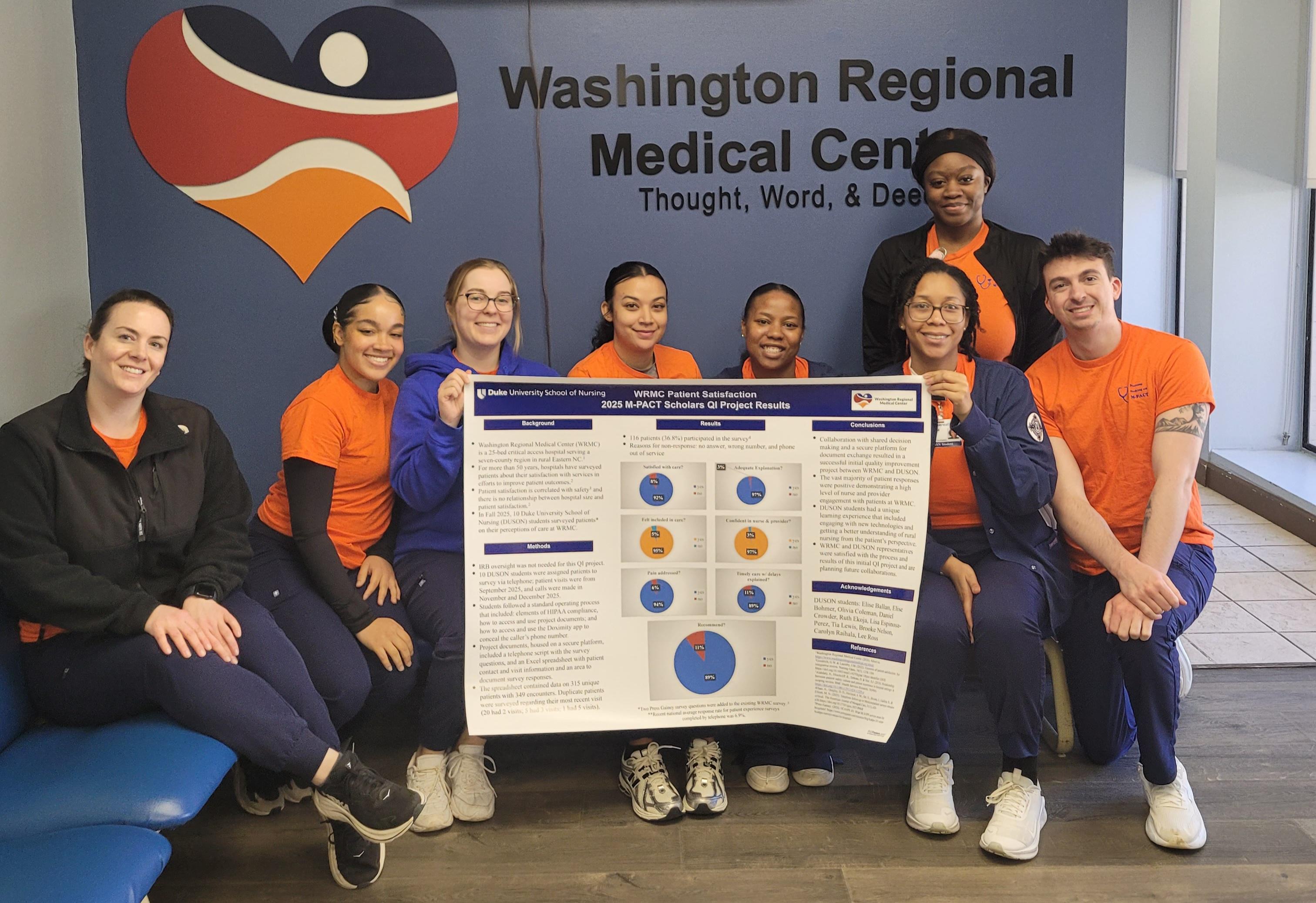
For the program’s Quality Improvement (QI) project, students partnered with Washington Regional Medical Center, a rural hospital serving seven counties in eastern North Carolina. The team conducted two types of calls: no-show follow-up calls reaching out to patients who missed appointments, documenting reasons, and offering rescheduling; and patient satisfaction calls asking recently seen patients about their experiences and concerns.
Raihala had prior experience with this kind of outreach, yet the new context shifted her perspective. “It was very hard to get in touch with these patients,” she said. “If we can’t reach them, we can’t understand their barriers… whether that’s transportation, resources, or something else.”
The challenges were embedded in geography and infrastructure. “[The hospital is] very rural,” she noted. “The next closest hospital is over an hour away. They have a wide service area, fewer resources, fewer providers.” When patients traveled long distances only to feel their needs weren’t met, frustration was understandable.
Unlike inpatient nursing—where a chart paints a fuller picture—these calls required openness and adaptability. “We just had a name and phone number,” Raihala said. “We had to be prepared for any emotional response. It was a steep learning curve, but so valuable.”
Serving Communities Beyond the Hospital Walls
M-PACT also places students in diverse community settings. Raihala recounted after-school events, vision and blood pressure screenings, and a caregiver health fair where the team offered assessments and connected attendees to on-site providers.
“We were on the ground talking to people and getting to know that population,” she said. “We were learning what the needs actually are in the communities around us.”
She was quick to highlight her peers, saying, “There are nine other truly amazing students in the program. They’re so passionate about why we’re at Duke—to advance health equity.”
The experience sharpened her understanding of how social determinants shape health outcomes, especially in rural settings. “As new graduate nurses, we’re going into a field where having a holistic perspective is going to be even more important,” she says. “We have to recognize where people need extra support so we can advocate for them.”
A Future in Pediatric and Behavioral Health Nursing
Raihala’s psychology background—her first degree was in psychology, and in college she shadowed at a psychiatric hospital—continues to shape her clinical interests. At the same time, she has enjoyed working with children since she was a teenager, making pediatrics also compelling.
“I think I want to try to combine pediatrics and behavioral or mental health care,” she explains—a path that would allow her to draw together her strengths in communication, empathy, and systems thinking.
Looking beyond graduation, Raihala plans to gain extensive bedside experience before pursuing a nurse practitioner degree. The NPs she once worked with continue to inspire her. “Their patients raved about them,” she said. “They had independence, clinical authority, and good work-life balance. I’m really drawn to that.”
Whether calling rural patients, supporting caregivers, or caring for children and families, Raihala strives to approach nursing with curiosity and humility.
“We have to recognize where people need extra support,” she said. “And we have to advocate for them.”