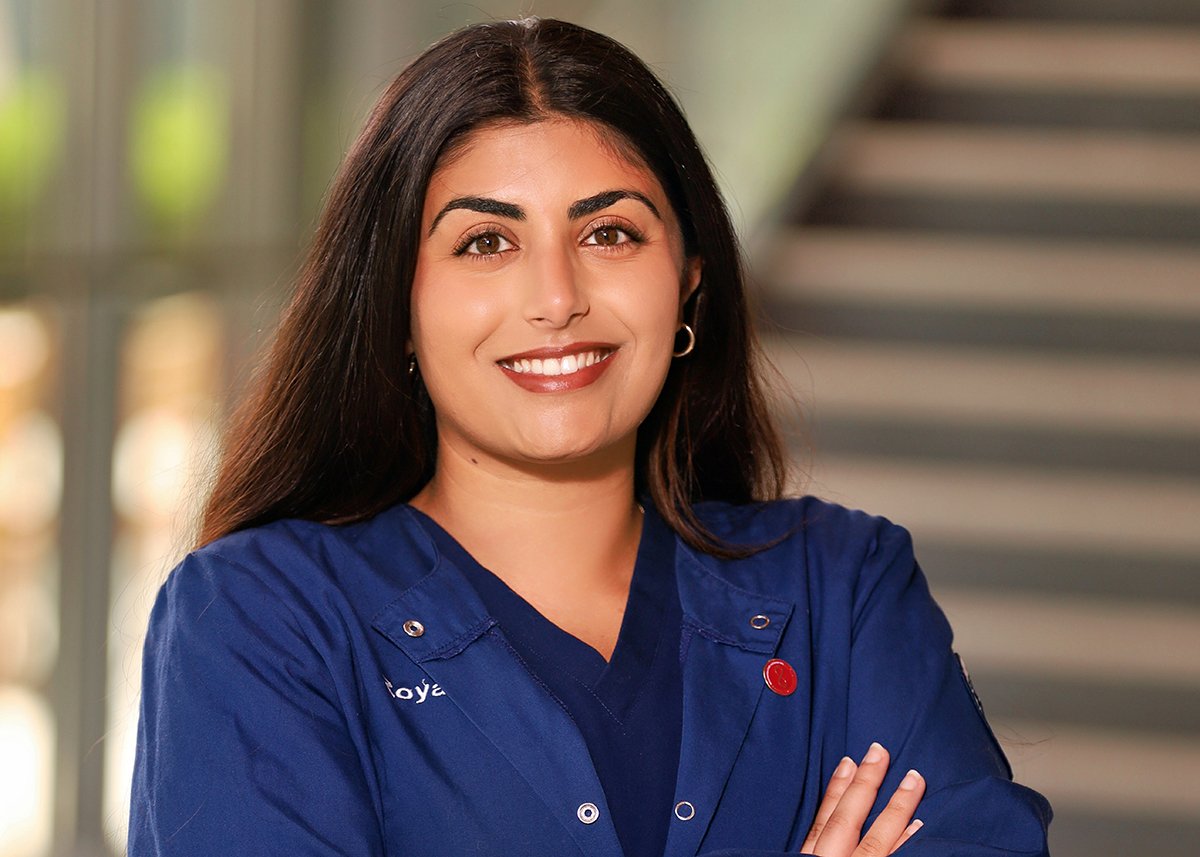
University Scholar Zoya Khan Finds Her Calling at Duke
Pre-licensure student and 2026 University Scholar Zoya Khan shares the path that led her to Duke, how the program has motivated and shaped her nursing journey, and what she sees for her future career.
University Scholar Zoya Khan’s path to Duke School of Nursing began long before she entered the Master of Nursing program. Raised in a Pakistani immigrant family just outside Knoxville, Tennessee, Khan grew up surrounded by nursing through her parents’ careers and by a deep admiration for Duke. But it was through her family’s experience navigating care for her younger brother, together with her volunteer work and time spent in hospitals, that Khan began to see nursing as a dynamic, intellectually challenging profession rooted in advocacy, science, and human connection. Now at Duke, she is building on those experiences as a 2026 University Scholar, preparing for a career grounded in compassionate, evidence-based care and a commitment to improving health access for patients and communities.
What first inspired you to pursue nursing, and what led you to Duke School of Nursing’s MN program?
I grew up just outside Knoxville, Tennessee, as the daughter of Pakistani immigrants. Although we lived in the heart of Volunteers country, I was raised a Blue Devil. When my father’s family first came to the United States, they spent a brief period in North Carolina, and my father came to view Duke as a symbol of academic excellence and possibility. Every year, we watched the Duke-Carolina game together, always rooting for “the better blue.”
My admiration grew in 2016, when I was invited to Duke TIP’s Grand Recognition Ceremony at Cameron Indoor Stadium. I still remember looking up at the banners hanging from the rafters and realizing that Duke was where I wanted to be.
A few years later, my younger brother was diagnosed with autism, and my family relocated to the Atlanta area so he could access better resources and support. Watching my family navigate specialists, schools, insurance, and therapy showed me how difficult it could be for families to access the care they needed. It also shaped many of the opportunities I pursued afterward. Throughout high school and college, I found myself drawn to volunteering with children with disabilities, patients, and underserved communities, both locally and abroad.
My parents are both nurses, so I grew up around the profession. Because nursing was so familiar to me, I assumed I already understood what it entailed and never really saw it as the path I wanted to pursue. I still found myself drawn to science and medicine but initially imagined a future in research.
My perspective changed when I had the opportunity to volunteer in hospitals in Lahore, Pakistan. For the first time, I was able to see nursing from the inside rather than from the outside. I watched nurses think critically, advocate for their patients, educate families, collaborate with the healthcare team, and adapt to constantly changing situations. It made me realize that nursing was far more dynamic, intellectually challenging, and impactful than I had ever understood.
I came away from that experience realizing that what excited me most wasn’t just understanding the science behind medicine, but applying that knowledge to patient care. Nursing offered me the perfect balance of critical thinking, lifelong learning, and meaningful human connection. Looking back, volunteering overseas completely changed the way I viewed the profession, and it confirmed nursing was exactly where I belonged.
I went on to earn my degree in Biomedical Sciences at the University of Alabama at Birmingham as a Presidential Scholar. By then, choosing nursing felt like a natural next step. It combined science, patient education, advocacy, and the opportunity to build lasting relationships with patients.
As I applied to nursing school, Duke was the only place I could picture myself. It had been part of my story for years, but it also offered the kind of education I knew would prepare me to become the nurse I wanted to be.
You were recently selected as a University Scholar—what does that recognition mean to you, and how do you hope to make the most of that opportunity?
Being named a University Scholar has been incredibly meaningful to me. I am tremendously grateful and honored to have been selected for this opportunity by the Duke University School of Nursing. I am now even more excited about the work I hope to accomplish during my time at Duke.
Long before coming to Duke, I knew I wanted to improve healthcare accessibility for individuals with disabilities, immigrants, and other underserved communities. Duke has given me the opportunity to explore those interests in much greater depth through community partnerships, advocacy, and service throughout Durham.
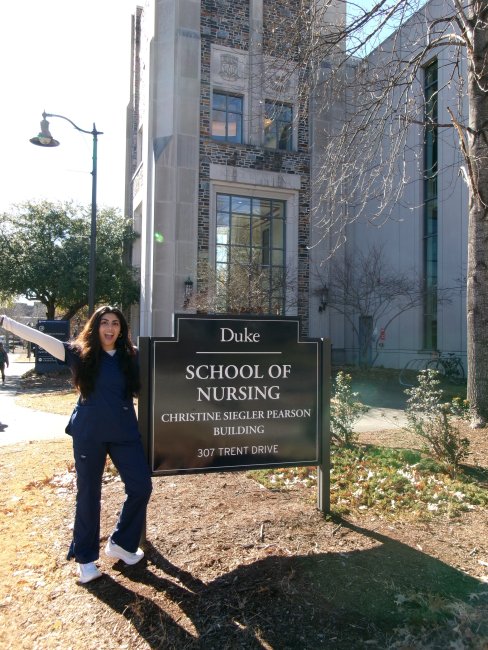
I hope to make the most of this opportunity by taking full advantage of everything the University Scholars Program has to offer. I'm excited to learn from faculty and students across Duke, explore new ways of approaching problems in healthcare, and continue building on the work and projects I've already started. I look forward to engaging with people whose experiences and perspectives are different from my own, challenging my thinking in ways I hadn't considered, and developing ideas that extend beyond the boundaries of nursing.
You mentioned an interest in critical care. What draws you to critical care nursing, and what kind of impact do you hope to have in that setting?
Critical care appeals to me because it combines complex clinical decision-making with the opportunity to care for patients during some of the most vulnerable moments of their lives. I enjoy environments that require careful assessment, teamwork, and the ability to stay calm under pressure. Every patient presents a unique clinical picture, and I appreciate the challenge of recognizing subtle changes, understanding how different conditions interact, and making thoughtful decisions as part of an interdisciplinary team.
I hope to have an impact by providing compassionate, evidence-based care that helps patients and their families feel supported during some of the most difficult moments they will face. I also hope to be the kind of nurse who advocates for patients when they cannot advocate for themselves and who never loses sight of the person behind the diagnosis.
How has your experience in the MN program shaped the way you think about patient care, leadership, or your future role as a nurse?
My experience in Duke's MN program has reinforced why I chose Duke in the first place. I came here because I wanted a nursing education that extended beyond the bedside, and the program has well exceeded those expectations. Through community partnerships like Open Table Ministry, interdisciplinary projects with students from across universities, and opportunities such as Nurses Night at the Legislature, I have experienced firsthand how nurses can improve health through advocacy, collaboration, and community engagement. Those experiences have shown me that nursing is not only about caring for patients at the bedside, but also about understanding the broader systems and social factors that shape their health.
Just as meaningful has been the mentorship and sense of community I have found within Duke. My professors have challenged me to think beyond finding the right clinical answer by asking how we can improve the systems our patients rely on and better serve our communities. They have encouraged me to pursue opportunities that align with my interests and have supported me as I've explored those interests both inside and outside the classroom. My peers have been equally influential. One of my favorite parts of being here at Duke has been learning alongside classmates who bring different perspectives and experiences, creating an environment where collaboration and mutual support are the norm.
These experiences have shaped the way I think about my future role as a nurse. I hope to provide excellent, evidence-based care at the bedside while remaining engaged in the work that happens beyond it. Duke has shown me that nursing offers countless opportunities to improve the health of individuals and communities alike.
Your fiancé will be joining the same program next year—what is it like to share this nursing journey with someone so close to you, and what are you both looking forward to?
Sharing this journey with Josh has been one of the most unexpected and rewarding parts of my nursing education. When we first met, I never imagined we'd both end up pursuing nursing, let alone at the same school. Knowing that we'll both be part of the Duke community is something we're incredibly grateful for, and I'm excited that we'll get to experience this chapter of our lives together. While we'll be in different cohorts, I look forward to encouraging one another through the challenges of nursing school, celebrating each other's accomplishments, and continuing to learn from one another along the way.

One of the things I appreciate most about Duke is that no two students have the same path into nursing. Josh and I are a good example of that. We come from different backgrounds, have different interests, and were drawn to nursing for different reasons, yet we both found a home here. The School of Nursing is just such a special community where people with different experiences and perspectives can learn from one another while working toward a shared purpose.
As we both continue our Duke journeys, I'm looking forward to seeing how our experiences shape us in different ways while knowing we'll always have someone who understands the challenges, milestones, and excitement that come with this profession. More than anything, I'm grateful that we'll get to build this future together at a place that already feels like home.
The University Scholar Award, which funds one year of tuition for graduate and professional students, was created in 1998 by the Office of the Vice-Provost of Interdisciplinary Studies with a gift from Duke University Trustee Emerita Melinda French Gates. The scholarships and program bring together students from Duke’s various undergraduate, graduate, and professional schools for seminars, informal mentoring, retreats and student-led symposia. Awards are offered to students who represent diverse personal and intellectual backgrounds and share an excitement for original research, collaborative thinking and innovative scholarship.