Building a Legacy: The Origins of Duke University School of Nursing
With only five years until our Centennial, the School has grown into an institution that prepares nurses to lead in an era of rapid technological, scientific, and societal change.
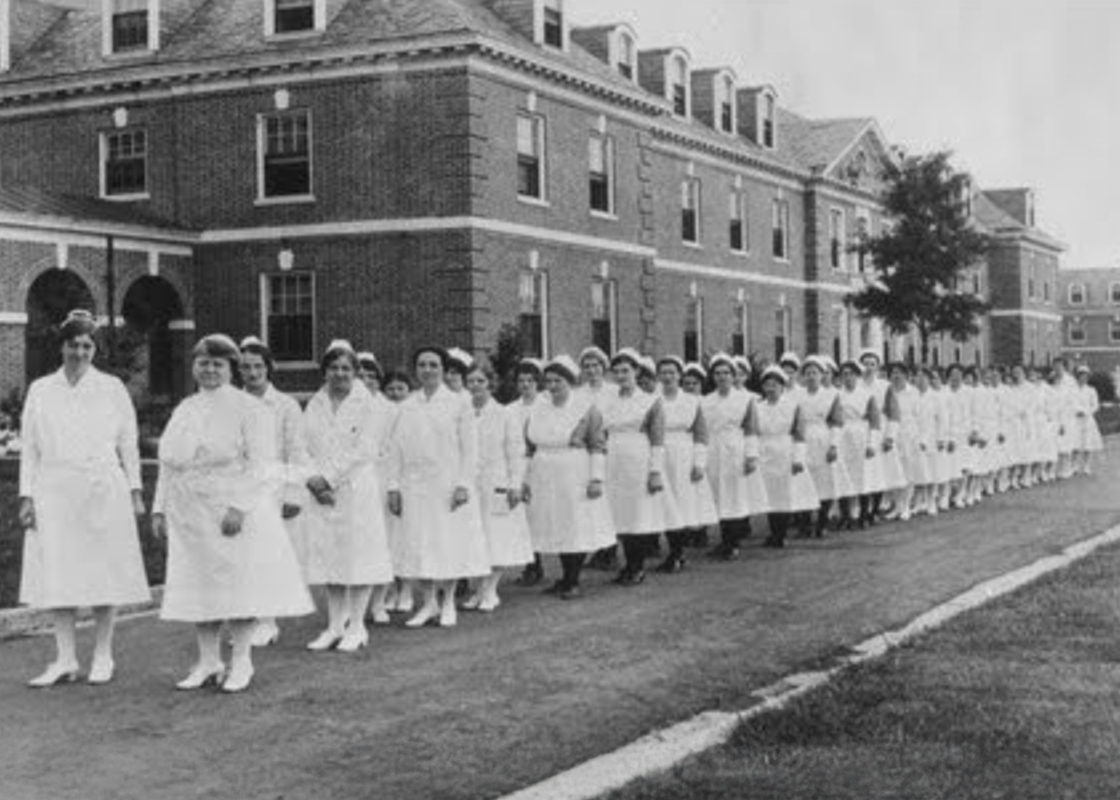
This story has been adapted from A History of Duke University’s School of Nursing (Volume One: 1931 to 1971).

Celebrating 95 Years of Excellence
As Duke University School of Nursing marks its 95th anniversary, we reflect on how far we’ve come since our founding. From a small, selective diploma program to a globally recognized leader in nursing education and research, the School has continually adapted to meet the needs of patients and communities. What began as a vision to create the best medical center between Baltimore and New Orleans has grown into an institution that prepares nurses to lead in an era of rapid technological, scientific, and societal change.
With only five years remaining until the School of Nursing celebrates its centennial, Dean Michael Relf, PhD, RN, ANEF, FAAN, says a historical understanding can help the School’s community better appreciate the visionary mindset needed to meet the current moment.
“As we approach our centennial, understanding our history is essential,” said Dr. Relf. “The vision and resilience that shaped Duke University School of Nursing in its earliest days continue to inspire us. While the world of nursing looks very different now, our history provides the foundation for how we evolve to continue to be a global leader in education, research, and clinical practice.”

A Vision for Excellence in Education & Care
In 1925, James Buchanan Duke’s $4 million bequest established Duke Hospital, the School of Medicine, and facilities to educate and train nurses—part of his goal to create the best medical center between Baltimore and New Orleans. From day one, nurses were the backbone of Duke Hospital’s operations. When the Hospital opened in July 1930 during the Great Depression, resources were limited, but nurses ensured patient care ran smoothly. Most were diploma-prepared and came from institutions like Stanford and Johns Hopkins. Wilburt Cornell Davison, MD, founding dean of the School of Medicine, was tasked with launching the new School of Nursing. Viewing the chief nurse as “the most important person in any hospital,” he led a nationwide search for a leader who could shape both patient care and nursing education.
Bessie Baker and Early Nursing Education
Dr. Davison wrote that everyone agreed that Duke should try to recruit Miss Bessie Baker, who had been the chief nurse of Base Hospital 18, during World War I at the Hopkins Unit at Bazoilles-sur-Meuse in France, while he was a patient there in 1917. She agreed to the position and became the first dean of the School of Nursing in 1930.
Baker, who would serve as dean until 1938, was a graduate of the Johns Hopkins School of Nursing and Columbia University. She served as the assistant director of Hopkins’s nursing school, as Director of Nursing at Charles T. Miller Hospital in St. Paul, Minnesota, and also as assistant professor of nursing at the University of Minnesota prior to her appointment at Duke. Dr. Davison later reflected that Baker’s dynamic personality and forceful character helped ensure the success of the School from its earliest days.

By 1931, Baker had recruited the first students to enroll in Duke’s new three-year nursing diploma program, writing personally to each individual who was accepted. Her official title at the Hospital is unclear, with various sources referring to her as chief nurse, hospital liaison, and director of nursing service. Her responsibilities included leading the nursing education enterprise and the delivery of nursing care. In the initial years of operation, enrollment in the School of Nursing was small and selective, the faculty holding students to high standards. The first class of twenty-four students enrolled in the new diploma program on January 2, 1931. A notice placed on the bulletin board at the School of Medicine read, “The student nurses have arrived. Do not feed or annoy them. Be gentle and entertain them.”
After two-and-a-half years of study, the first fourteen nurses graduated in June 1933. The School’s first students had one instructor who taught nearly all their courses: Ann Henshaw Gardiner, MS, RN, assistant professor of nursing education. Miss Gardiner served as educational director at Baylor School of Nursing in Texas, Flushing Hospital School of Nursing in New York, and Stanford University School of Nursing in California prior to coming to Duke University in 1930. The curriculum, the prerequisites for admission, and student life were all evolving quickly at the fledgling School. School bulletins beginning in 1931 list the entrance requirements as “intelligence, character, and graduation from an acceptable high school.” By the late 1930s, the School of Nursing required one year of college work for admission to the nursing program.
From its beginning through 1944, enrollment grew from fifty-seven to 275 students and the faculty from two to nineteen. 95 years later, Duke University School of Nursing has 91 full-time faculty and more than 1,200 students—and stands at the forefront of a rapidly evolving profession.
“Advances in technology and shifting healthcare needs are transforming the way nurses care, lead, and innovate,” said Dean Relf. “With a steadfast commitment to preparing clinicians to use evidence to inform person-, family-, and community-centered care, Duke will continue to lead with vision, expertise, and dedication to improving health for all people.”