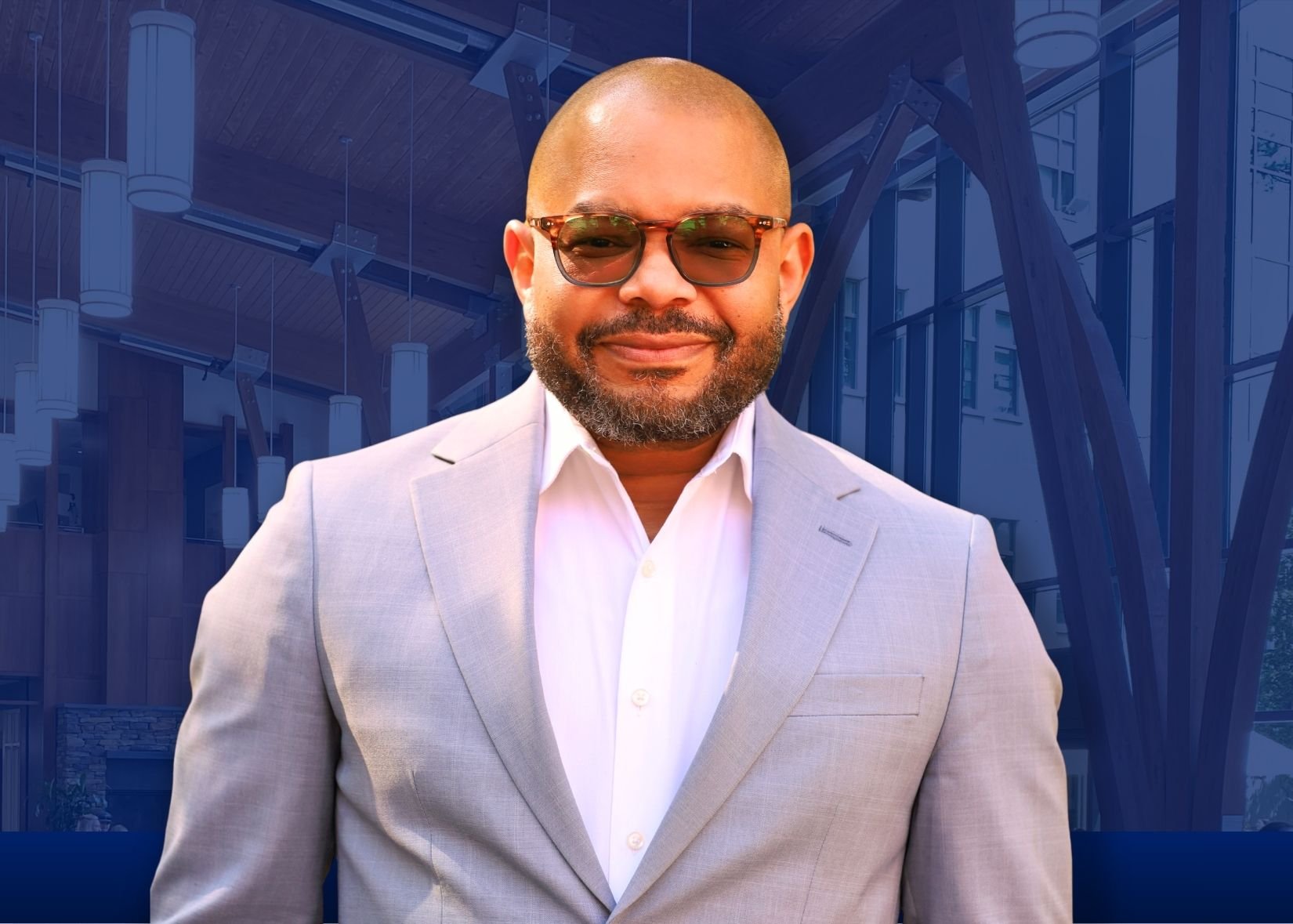
“Early Treatment Is a Family Intervention”: A Q/A With Mental Health Specialty Director Lem Scott
Nursing faculty Lem Scott, the new director of the Psychiatric-Mental Health major, discusses his research on intergenerational trauma and his pathway through Duke.
Lem Scott, DNP, PMHNP-BC, CNE, is Assistant Professor at the Duke School of Nursing and Director of the Psychiatric-Mental Health Major. A three-time graduate of the School, he shares his pathway through his degree programs to his faculty position, his research on adverse childhood experiences and intergenerational trauma, and how to better support mental health awareness.
You received your prelicensure, MSN, and DNP degrees from the Duke School of Nursing. What made you choose Duke for all three degrees?
The mission is what brought me here, and it's what kept me here. Duke's focus on the underserved, underrepresented, and vulnerable, and on improving not only care but the systems that deliver it, matched what I wanted my career to be about. I'll be honest, though: when I first arrived, I wondered whether I would actually belong. The prelicensure program settled that question.
I returned for the MSN because of the rigor. I was looking for a program that would teach me the craft and also change how I think, and those are not the same thing. Many programs do the first well. Fewer do the second. The DNP decision was simpler still. By then I understood what the outcome would be. I knew that when I finished, I would be prepared to practice and to lead, and that certainty is worth more than convenience.
What were some of the highlights of your time as a "triple Dukie" student?
Mentorship stands out first, and it came from more directions than I expected. Bridget Carter, Helen Gordan, Maggie Molloy, Beth Phillips, Nancy Crego, Jill Brennan-Cook, Sean Convoy, Anne Derouin, Jamie Lord, and many more invested in me both formally and informally. My peers mattered just as much. Sitting with people whose clinical backgrounds and lived experiences differed from mine forced me to examine assumptions I had not realized I was carrying. That kind of learning does not appear on a syllabus.
The other memory is less glamorous. I spent an enormous amount of time learning the foundational courses and skills—far more than was strictly required. Years later, in my NP program, that work paid dividends I could not have predicted. It still shapes how I approach diagnostic reasoning. When I practice alongside colleagues trained elsewhere, the difference in that foundation is visible to me.
What kinds of research are you engaged in as an Assistant Professor at the School of Nursing?
My scholarship examines how adverse childhood experiences and early trauma translate into mental health and substance use conditions in adulthood, and how those adult conditions frequently generate new trauma exposure for the next generation of children. The intergenerational nature of that pattern is what interests me most, because it is where prevention and treatment stop being separate conversations.
Three strands of work follow from that. The first uses photovoice, where participants document their own experience through images and narrate what those images mean, shifting interpretive authority away from the researcher. Impact is not as measurable, but this research method provides context around stigma, agency, and daily functioning that standard data collection routinely misses.
The second is milieu management. Where a patient receives care shapes outcomes as much as what they are prescribed, and the therapeutic environment is often the least examined variable in an inpatient or crisis setting.
The third is the use of simulation in teaching. As a DNP, my scholarship is oriented toward translation, so I am interested in how simulation builds diagnostic reasoning, risk formulation, and documentation skill before a student ever sits with a patient.
What classes do you teach?
My teaching spans the Psychiatric-Mental Health specialty sequence. I teach Introduction to Advanced Practice Psychiatric Mental Health Nursing, which is where students build their foundation in psychiatric assessment and diagnostic nosology (which deals with the classification of diseases), along with Psychopharmacology for the Advanced Practice Nurse.
I also teach the paired courses in Diagnosis and Evidence-Based Treatment of Mental Health Disorders Across the Lifespan, one didactic and one clinical, taken in the same semester. That pairing is deliberate. Diagnostic reasoning and risk formulation are not acquired through lecture alone, nor are they acquired in clinical placement without a conceptual framework to hang them on. Students need to encounter the framework and apply it to real patients close enough together that the two reinforce each other.
What do you hope to bring to your new role as Director of the Psychiatric-Mental Health Nurse Practitioner (PMHNP) MSN program?
My first priority is to steward what already works. This program has been recognized as the top PMHNP program for seven consecutive years, and that record reflects the sustained effort of a faculty group that came before me. A new director's instinct to redesign is not always the right instinct.
Second, I want to find innovative ways to deliver the material. Content quality and content delivery are separate problems, and in a distance-based program the delivery problem is frequently the binding one. Any innovation also has to be feasible for faculty already carrying full teaching and practice loads, which means being selective rather than ambitious about what we change in a given cycle.
Third, we have to keep pace with practice. Psychiatric prescribing, regulatory expectations, and the substances patients actually present with all shift faster than curricula typically do. Closing that gap is ongoing rather than something you finish.
All three priorities serve one outcome. Our graduates should be safe in practice, and they should feel confident and competent sitting at the table with their medical colleagues. Confidence without competence is dangerous. Competence without confidence leaves capable clinicians hesitant to advocate for their patients. We are responsible for both.
You are also a decorated military veteran. Has this experience contributed to your research in mental health? How so?
Service placed me among people who were managing things they had been conditioned not to discuss. I did not yet have the vocabulary of adverse childhood experiences or trauma-informed care, but I was watching what happens when trauma goes unnamed. It surfaces as substance use, as irritability, as withdrawal from the people who could help, as almost anything other than a direct request for support. That observation is the throughline to my scholarship today. Service also gave me a tolerance for high-acuity, unpredictable environments that has served me well in crisis care, where the presentation you prepare for is rarely the one that arrives.
Why is mental health awareness so important, and what are some aspects of mental illness that we often miss? How can we support increased awareness?
Two things get missed consistently. The first is that mental illness rarely resembles the image we hold of it. We expect visible sadness. What actually presents is irritability, exhaustion, somatic complaints, a shortened fuse with one's children, a quiet decline in work performance. Because those signs do not match the expected picture, the people closest to someone are often the last to name what they are seeing.
The second is that substance use is usually a symptom rather than the diagnosis. In crisis care I see the full range, from alcohol and opioids to kratom, inhalants, and hallucinogens. Untreated trauma sits underneath a substantial portion of it. Treating the substance without addressing what it is regulating means treating the smoke and leaving the fire.
"If I could ask readers to do one thing, it would be to talk about mental health with their families and friends. Discussion is the first step toward dismantling stigma."
Illness does not stay contained within the person carrying it. Untreated mental illness in a parent frequently becomes an adverse childhood experience for that parent's child, which is precisely how one generation's trauma becomes the next generation's diagnosis. Early treatment, viewed correctly, is a family intervention.
If I could ask readers to do one thing, it would be to talk about mental health with their families and friends. Discussion is the first step toward dismantling stigma. Consider the comparison: no one carries shame about seeing a neurologist for a structural problem in the brain. Mental health concerns the function of that same organ. There is no defensible reason for one to carry weight that the other does not.